
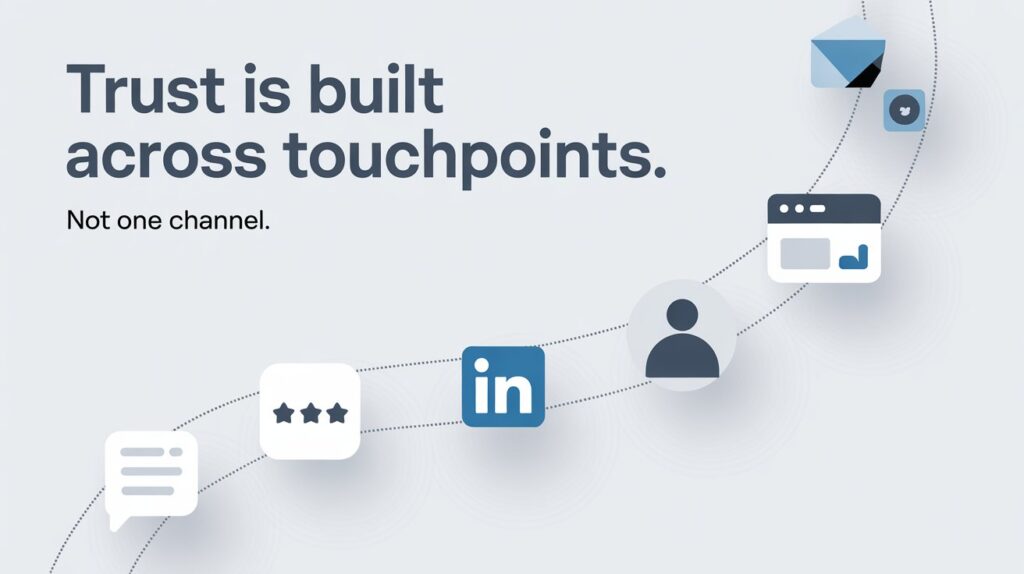
Your Marketing Is Not One Channel. It Is a Trust Trail
Most businesses think about marketing in channels.
They ask:
Is LinkedIn working?
Is SEO working?
Are Google reviews working?
Is the website working?
Are blogs working?
Is email working?
Are ads working?
These are fair questions.
But buyers do not think this way.
A buyer does not usually see one post, click one button, and immediately become a customer.
They move through a series of small trust checks.
They might see your LinkedIn post.
Then visit your website.
Then search your company name on Google.
Then look for reviews.
Then check your founder’s profile.
Then compare you with another provider.
Then come back later when the need becomes more urgent.
From your side, it may look like one lead came from one source.
But from the buyer’s side, the decision was built across multiple touchpoints.
That is why your marketing is not one channel.
It is a trust trail.
What Is a Trust Trail?
A trust trail is the path a buyer follows before deciding whether your business feels credible enough to contact, consider, or choose.
It includes every place where they quietly judge you.
Your website.
Your LinkedIn page.
Your Google search results.
Your reviews.
Your blog content.
Your case studies.
Your social activity.
Your founder profile.
Your service pages.
Your brand presentation.
Each touchpoint either adds trust or creates doubt.
This matters because buyers today rarely rely on one source of information.
They do not only look at your website.
They check whether your business feels real, active, relevant, and safe.
If one touchpoint is strong but the others are weak, the trust trail breaks.
The Buyer Journey Is Not as Simple as It Looks
Many companies look at marketing attribution too simply.
They might say:
“This lead came from LinkedIn.”
Or:
“This lead came from Google.”
Or:
“This lead came from a referral.”
But that is rarely the full story.
A buyer may have discovered you on LinkedIn, but only reached out after checking your website.
Another buyer may have searched you on Google after receiving a cold email.
Someone else may have seen your content for months before finally booking a call.
Another prospect may have been referred to you, but still checked your reviews, website, and social presence before responding.
That means the visible source of the lead is not always the full source of trust.
The conversion may happen on one channel, but the trust was built across several.
Why One Strong Channel Is Not Enough
A business can have a great LinkedIn presence but a weak website.
That creates doubt.
A business can have a good-looking website but no reviews.
That creates hesitation.
A business can have strong SEO traffic but unclear messaging.
That creates confusion.
A business can have good content but no proof.
That creates risk.
This is why one strong channel is not always enough.
Buyers do not only ask:
“Can I find this company?”
They also ask:
“Can I trust this company?”
And trust does not usually come from one place.
It comes from consistency.
If your LinkedIn says you are active and knowledgeable, your website should support that.
If your website says you are credible, your reviews should support that.
If your content says you understand the market, your service pages should support that.
If your outreach creates interest, your online presence should make the next step feel safe.
When these pieces work together, your marketing becomes stronger.
When they do not, buyers quietly lose confidence.
The Silent Buyer Is Always Checking
One of the biggest mistakes businesses make is assuming that only active leads matter.
But many buyers are silent before they ever raise their hand.
They do not comment.
They do not like your posts.
They do not fill out your form.
They do not reply immediately.
They do not tell you they are researching.
They just watch.
They check your website.
They look at your LinkedIn activity.
They read your content.
They search your name.
They compare you with competitors.
They ask someone internally.
They come back later.
This is why brand visibility matters.
Not because every touchpoint creates an instant lead.
But because every touchpoint shapes how safe the buyer feels when the timing is right.
The Problem With Disconnected Marketing
Disconnected marketing happens when each channel tells a different story.
For example:
Your LinkedIn content talks about strategy, but your website feels generic.
Your website says you are premium, but your reviews are missing.
Your outreach sounds sharp, but your online presence looks inactive.
Your blog content is educational, but your service pages are vague.
Your Google presence exists, but it does not build confidence.
Your company page looks unfinished, but your sales message asks for trust.
This creates friction.
The buyer may not consciously think, “This company has inconsistent marketing.”
But they feel it.
Something feels incomplete.
Something feels risky.
Something makes them pause.
And in most cases, they do not tell you why.
They just choose someone else or do nothing.
What a Strong Trust Trail Looks Like
A strong trust trail does not mean every channel has to be perfect.
It means every major touchpoint supports the same idea.
The buyer should feel a consistent message wherever they find you.
Your LinkedIn should create familiarity.
Your website should create understanding.
Your SEO presence should create discoverability.
Your Google reviews should create confidence.
Your blog content should create authority.
Your case studies should create proof.
Your founder profile should create a human connection.
Your service pages should create clarity.
Together, these pieces make your business easier to trust.
That is where strong digital marketing becomes more than visibility.
It becomes decision support.
LinkedIn Creates Familiarity
LinkedIn is often not where the sale happens immediately.
It is where familiarity starts.
When people see your posts regularly, they begin to understand how you think.
They see your opinions.
They see your expertise.
They see the problems you talk about.
They see your point of view.
They see whether your business feels relevant to them.
This matters because people usually trust what feels familiar.
A strong LinkedIn presence makes your business less cold before the first conversation.
But LinkedIn alone is not enough.
Once someone becomes interested, they usually check other touchpoints.
That is where the rest of the trust trail matters.
Your Website Creates Understanding
Your website should answer the buyer’s most important questions quickly.
What do you do?
Who do you help?
What problem do you solve?
Why should someone trust you?
What makes your approach different?
What should the visitor do next?
A website should not just look nice.
It should reduce confusion.
If someone comes from LinkedIn, email, Google, or referral, your website should make the next step easier.
A weak website breaks trust because it forces the buyer to guess.
And when buyers have to guess, they often leave.
Google Reviews Create Confidence
Reviews matter because they provide outside validation.
Your own website will naturally say good things about your business.
But reviews show that other people have experienced working with you.
For many businesses, especially service businesses, Google reviews can make the company feel more real.
They help buyers answer:
Has this company worked with others?
Do people trust them?
Are they reliable?
Do they deliver what they promise?
Even a small number of strong reviews can support the decision-making process.
Not because reviews close every deal by themselves.
But because they reduce doubt.
SEO and Search Visibility Create Legitimacy
When a buyer searches for your business, what do they find?
This is an underrated part of trust.
If your company barely appears, looks inactive, or has inconsistent information, the buyer may hesitate.
Search visibility is not only about ranking for high-volume keywords.
It is also about being easy to verify.
Your business should be findable.
Your website should appear properly.
Your Google profile should be accurate.
Your content should support your expertise.
Your brand name should lead to credible results.
This is especially important when buyers discover you through outbound, referrals, or LinkedIn.
They may not reply right away.
They may search you first.
Content Creates Authority
Content helps buyers understand how you think.
It shows whether you understand their problems.
It gives them a reason to keep paying attention.
But content only works when it has a clear point of view.
Generic content does not build much trust.
Posts like “5 tips to improve your marketing” or “Why branding matters” are everywhere.
They may be correct, but they are forgettable.
Strong content should make the buyer think:
“They understand this problem.”
That is what creates authority.
Not just posting often.
Posting with insight.
Case Studies Create Proof
A case study is one of the strongest trust-building assets a business can have.
It shows the buyer what your work looks like in context.
It answers questions like:
What problem did the client have?
What did you do?
What changed?
What was the process?
What kind of result or improvement happened?
Even simple case studies can help.
They do not always need to be huge success stories.
Sometimes a before-and-after explanation is enough to make your work more believable.
Proof turns claims into something the buyer can evaluate.
Why This Matters for Service Businesses
For service businesses, trust is everything.
The buyer is not only buying a product.
They are buying judgment, execution, communication, and reliability.
That means they need more than a list of services.
They need to feel that the business understands their situation and can handle the work properly.
This is why a complete digital presence matters.
A service business with a strong trust trail has an advantage.
Not because it is louder.
But because it feels safer.
A Simple Trust Trail Audit
Here is a simple way to check your own marketing.
Search your business name on Google.
Then ask:
Does the business look active?
Does the website clearly explain what we do?
Do our reviews support trust?
Does our LinkedIn page look current?
Does our content show expertise?
Are our service pages clear?
Can a buyer find proof easily?
Does our message feel consistent across channels?
Would a stranger trust us enough to book a call?
If the answer is no, the issue may not be one channel.
It may be the full trail.
Final Thought
Marketing is not just about being seen.
It is about being trusted.
A buyer may discover you in one place, evaluate you in another, and contact you somewhere else entirely.
That is why every touchpoint matters.
Your LinkedIn.
Your website.
Your reviews.
Your SEO.
Your content.
Your case studies.
Your Google presence.
They are not separate pieces.
They are connected signals.
And every signal either builds trust or weakens it.
So instead of only asking, “Which channel is working?”
Ask a better question:
“Does every touchpoint make the buyer feel safer choosing us?”
That is the real job of marketing.
Not just traffic.
Not just attention.
Trust.