
AI Website Builders vs. Custom Development: What’s Missing
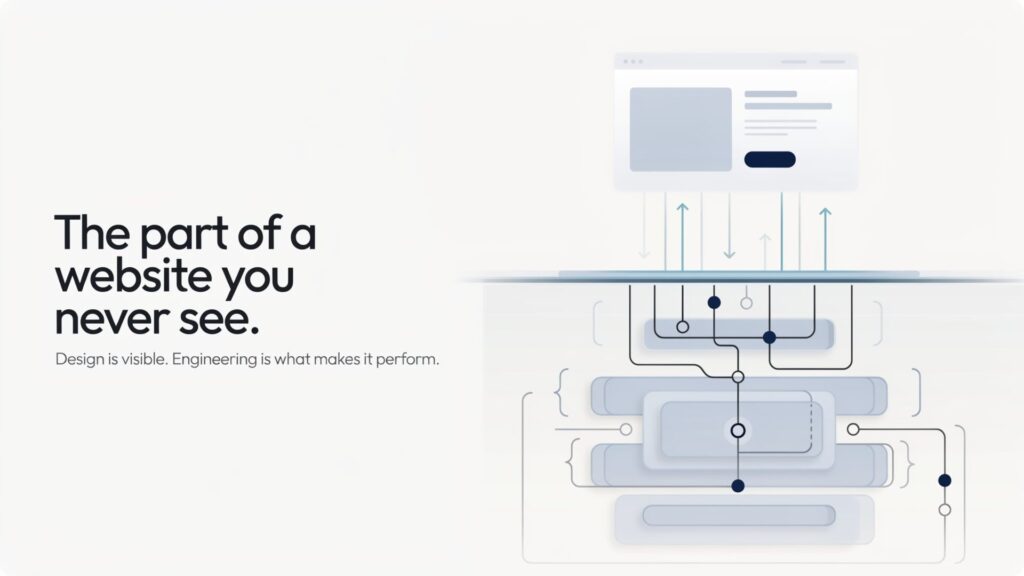
When you look at a website, you see the surface: the layout, the colors, the images, the words. That’s maybe ten percent of what a website actually is.
The other ninety percent is underneath, the structure of the code, how the page loads, how search engines read it, how it behaves on a slow connection or a screen reader, how easily it can be changed six months from now. None of that shows up in a preview. All of it determines whether the site actually performs.
This is the crux of an honest conversation about AI website builders. These tools have gotten genuinely good at the ten percent you can see. Point them at a prompt and they’ll produce something that looks clean and modern in the preview window. That’s real, and it’s worth acknowledging.
The problem is that they optimize almost entirely for that visible layer — and systematically neglect the ninety percent underneath, because the underneath doesn’t show up in the output you’re judging them by.
Let’s be specific about what actually gets left out, because “AI code is worse” is too lazy a claim to be useful. Sometimes it isn’t. But it’s consistently incomplete in ways that matter, and here’s where.
- Semantic Structure: The Code Search Engines Actually Read
Every webpage is built from HTML elements, and those elements carry meaning. A heading tagged as a heading, a navigation menu tagged as navigation, a button that’s actually a button, this is called semantic structure, and it’s how search engines and assistive technology understand what your page is.
AI builders frequently produce output that looks correct but is semantically hollow: a wall of generic containers styled to look like headings and buttons, without the underlying tags that tell a machine what they are. Visually identical. Structurally meaningless.
The cost shows up where you can’t see it. Search engines lean on semantic structure to understand and rank your content. A page that looks like a well-organized article but is coded as an undifferentiated blob gives Google far less to work with. You’ve built something that reads beautifully to a human and confusingly to the one reader that decides whether anyone finds you.
A developer who knows what they’re doing builds the meaning into the markup from the start. That’s not visible in a screenshot, which is exactly why an AI optimizing for screenshots skips it.
- Performance Under Real Conditions
AI-generated sites tend to look fast in the preview, because the preview runs in ideal conditions, fast connection, modern device, nothing else loading.
Real users aren’t in ideal conditions. They’re on mid-range phones, patchy mobile data, with a dozen tabs open. Performance under those conditions is an engineering problem, and it’s one AI builders routinely handle poorly: oversized images served at full resolution, scripts that load in a blocking sequence, unused code shipped to every visitor, no meaningful attention to what loads first.
This matters commercially, not just technically. Page speed directly affects both search ranking and conversion, slow pages lose visitors before they ever see your offer, and Google factors loading performance into where you rank. A site that’s visually impressive and three seconds too slow is quietly leaking the traffic it worked to attract.
Optimizing real-world performance requires deciding what to load, when, in what order, and at what size. Those are judgment calls a skilled developer makes deliberately. An AI builder generating a good-looking result has no reason to make them, because slowness doesn’t show up in the preview either.
- Accessibility: The Legal and Ethical Layer
Roughly one in five people has a disability that affects how they use the web. Accessibility, proper labels, keyboard navigation, sufficient color contrast, screen-reader compatibility, determines whether those people can use your site at all.
It’s also, increasingly, a legal exposure. Businesses have faced lawsuits over inaccessible websites, and the standards are well-defined.
AI builders are inconsistent here at best. They’ll often produce interfaces that are impossible to navigate without a mouse, images with no alternative text, and color combinations that fail contrast standards, because none of those failures are visible to a sighted person clicking through a preview. The site “works” for the person evaluating it and quietly excludes a fifth of the actual audience.
Building for accessibility means thinking about people who interact with the page in ways the builder never tests for. That’s a human consideration, and it’s one that a tool optimizing for visual output has no path to.
- Maintainability: The Cost That Arrives Later
Here’s a cost nobody feels on day one and everybody feels eventually.
A website is not a finished object. You’ll want to change it, add a page, update a section, integrate a tool, fix something that broke. How easy that is depends entirely on how the code underneath was organized.
Well-built sites are structured so that a change in one place doesn’t break three others, so that components are reusable, so that the next developer can understand what’s happening. AI-generated code is frequently the opposite: repetitive, disorganized, full of one-off patches that made the preview look right. It works until you need to change it, and then every change is a small excavation.
This is the trap of judging a website by how it looks the day it’s built. The bill for messy underlying code doesn’t arrive at launch. It arrives every time you try to evolve the site afterward, and it compounds.
Where AI Builders Genuinely Fit
To be fair, because the honest version of this argument is more persuasive than the exaggerated one: AI builders are a legitimately good fit for some situations. A quick landing page to test an idea. A simple personal site. A throwaway page for a short campaign. Situations where the site is temporary, low-stakes, and won’t need to rank, scale, or evolve.
The mismatch happens when a business treats an AI-generated site as its permanent commercial foundation, the thing that has to load fast, rank well, stay accessible, convert visitors, and grow with the company for years. That’s not the job these tools are built for, and the gaps only surface once the site is doing real work.
The Honest Takeaway
The difference between an AI-built site and a professionally developed one isn’t usually visible in a side-by-side screenshot. That’s precisely why it’s so easy to underestimate.
The visible layer is where AI builders compete well. The invisible layer, semantic structure, real-world performance, accessibility, maintainability is where the actual value of a website lives, and it’s exactly what these tools neglect because it never shows up in what you’re looking at.
A skilled developer builds for the ninety percent you can’t see. An AI builder optimizes for the ten percent you can. For a temporary page, that trade is fine. For the site your business runs on, it’s the difference between something that looks good today and something that performs for years.
My Brand Alchemy builds websites engineered under the surface, not just designed on top of it, structured for performance, search visibility, accessibility, and long-term growth. If you’re weighing an AI-built site against custom development, let’s talk about what your business actually needs.