
The Hidden Cost of a Slow Website: Leads You Never Knew You Lost
The Leak You Can’t See
Most business problems announce themselves. A slow website doesn’t.
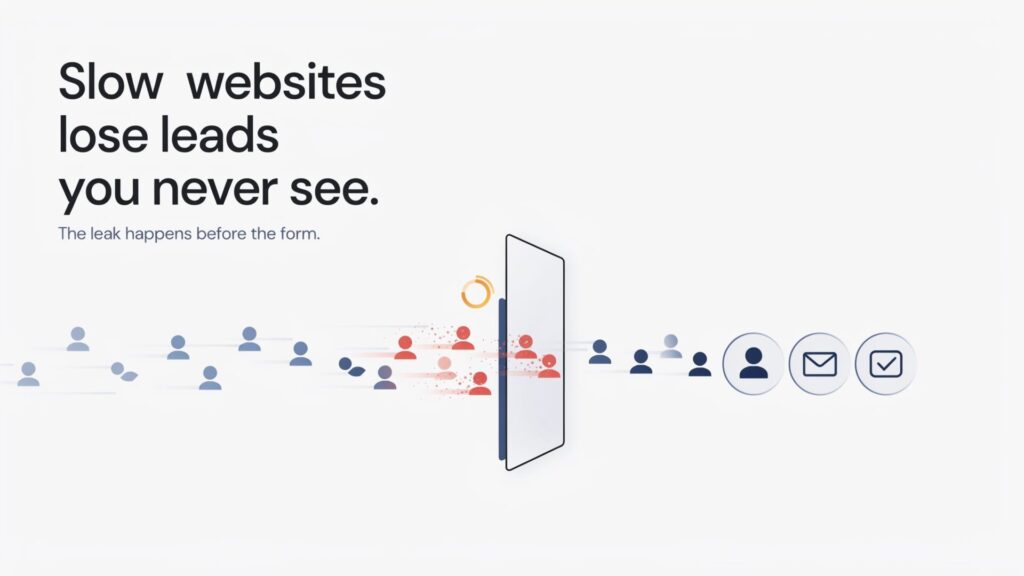
When outreach underperforms, you see low reply rates. When a campaign fails, you see the empty calendar. But when your website is costing you leads, you see nothing, because the people you’re losing never became data. They arrived, waited a beat too long, left, and were never counted as anything but a flicker in your traffic. There’s no line on any report labeled “people who would have converted if the page had loaded faster.”
That’s what makes site speed the most under-diagnosed leak in most funnels. Everything upstream can be working, the outreach lands, the ad gets the click, the search result earns the visit — and a slow load quietly deletes a portion of that hard-won traffic before it ever reaches a form. You paid for the visitor. The page lost them. And nothing on your dashboard tells you it happened.
Why a Few Seconds Costs So Much
The reason speed matters this much is that it’s the first thing a visitor experiences, before your copy, your offer, or your design gets a chance to work.
A visitor who clicks through to your site has a fragile amount of intent. They’re willing to give you their attention, but only briefly, and a blank or half-loaded screen spends that willingness fast. Every additional second of load time measurably increases the share of people who abandon before the page even appears. The relationship isn’t gentle, bounce probability climbs sharply as load time grows, and much of that abandonment happens in the first few seconds, before anyone has seen a word you’ve written.
What makes this especially costly is where it happens in the funnel. This isn’t losing people who were never interested. It’s losing people who were interested enough to click, the most valuable traffic you have. You did the hard work of earning the visit through outreach, content, or ads, and then lost the visitor at the cheapest, most fixable step. Every one of those abandonments is a fully paid-for lead thrown away at the door.
And it compounds. A visitor who bounces from a slow page rarely comes back, and often leaves with a quiet impression that the company is a little sloppy, a little behind. Speed isn’t just a conversion factor. It’s a first, silent statement about how the business operates.
The Second Cost: Search Doesn’t Send Slow Sites Traffic
There’s a compounding penalty most people miss. A slow site doesn’t just lose the visitors it gets, it gets fewer visitors to begin with.
Search engines treat page speed and loading experience as a ranking factor. A slow site is quietly ranked lower, which means it appears further down, earns fewer clicks, and gets less traffic before speed ever gets a chance to cost you a conversion. The loss stacks: fewer visitors arriving, and a smaller share of those converting once they do.
So the slow site is penalized twice, at both ends of the same funnel. It’s shown to fewer people, and it converts fewer of the people it’s shown to. Two separate leaks, same root cause, and neither one shows up as an obvious problem you can point at.
Why This Stays Invisible
The cruel part is that the people who would tell you about the problem are exactly the people you’ve already lost.
The visitors who stuck around, the ones who became leads, who filled out the form, who showed up in your analytics, are by definition the ones for whom the site was fast enough. Your data is composed entirely of survivors. The people the speed drove away aren’t in your funnel to complain, aren’t in your conversion numbers, and aren’t anywhere you’d naturally look. The absence is invisible precisely because it’s an absence.
This is why slow sites persist for years inside otherwise sharp businesses. Nothing is visibly broken. The site works. It loads, eventually. The forms submit. And the steady, quiet erosion of interested visitors never surfaces as a problem anyone flags, because the evidence of it walked away before it could be recorded.
Where This Leaves You
If you’re investing in outreach, content, or ads to drive traffic to your site, page speed isn’t a technical detail, it’s the point where a real share of that investment silently succeeds or fails. Everything you spend to earn a visit is riding on the page’s ability to actually appear before the visitor gives up.
The good news is that unlike most leaks, this one is fixable and measurable. Speed can be tested, and improvements convert directly into visitors who now make it to the form who previously wouldn’t have. It’s one of the few places where a technical fix produces a straight line to more leads from the exact same traffic.
This is why we treat site performance as part of lead generation, not just design: the fastest way to get more from your existing outreach and search traffic is often to stop losing it at the door. You already earned those visitors. The site shouldn’t be quietly turning them away.